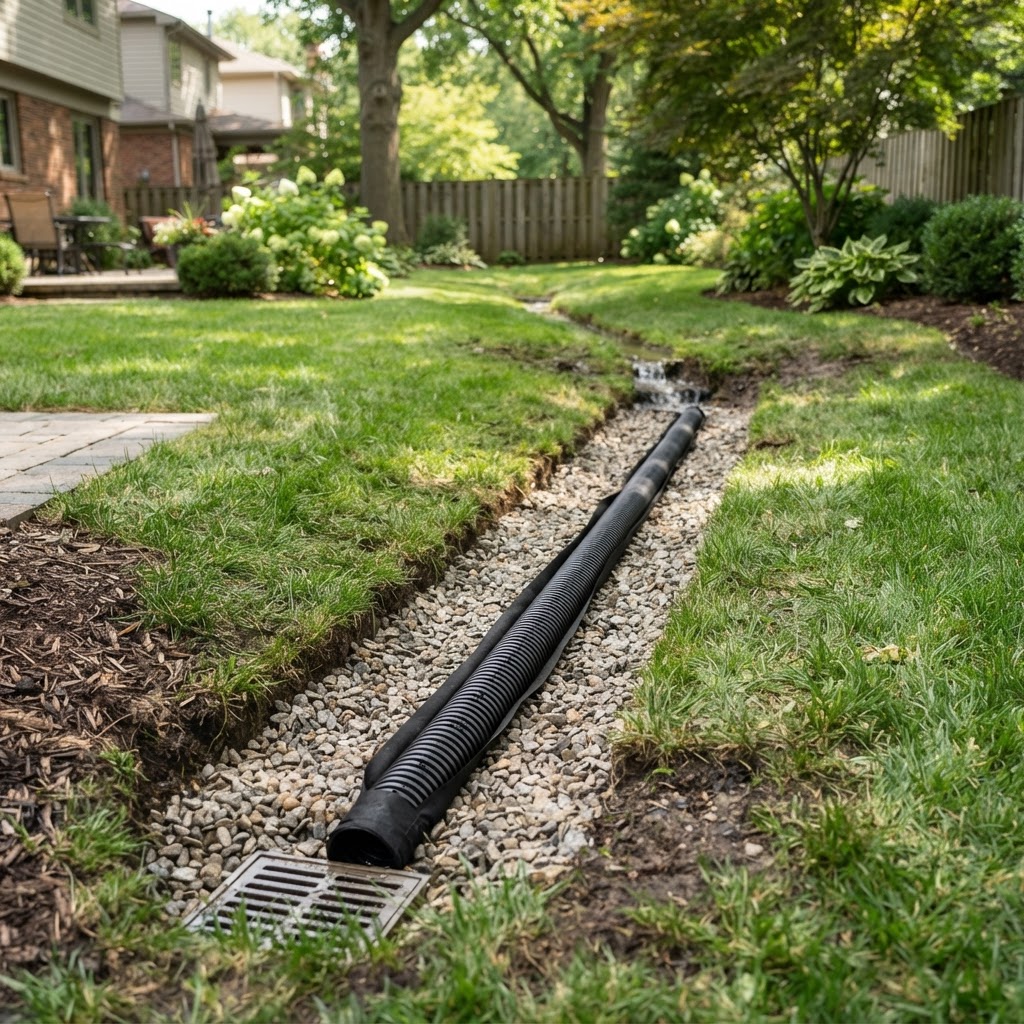
French Drain Installation and Repair
A French drain is a gravel-filled trench with a perforated pipe that collects water and directs it somewhere it can drain safely. It is one of the most versatile tools in drainage — used to dry out a persistently wet yard, to intercept water running down a slope toward a house, or to supplement a foundation drainage system. The name gets used loosely; what matters is that the drain is sized, located, and built for the specific water problem on your property.
French drain vs. perimeter drain
People use the terms interchangeably, but they are not the same thing. A perimeter drain runs around the footing of a foundation, below floor level, and its job is to relieve groundwater pressure against the foundation wall. A French drain is a surface or shallow subsurface trench that collects water moving across or just under the ground — typically in a yard, along a slope, or along a driveway. A French drain can feed into a perimeter system or a storm line, but it solves a different problem at a different depth.
Where a French drain helps
A French drain is the right solution when water is collecting or moving across the surface and you need to intercept it and carry it away.
- A low spot in the yard that stays soggy for days after rain
- Water running down a slope toward the house during heavy rain
- Surface water pooling beside a driveway or patio
- A downspout discharge that is eroding a area of lawn
- A property line where runoff from a neighbour is entering your yard
Building a French drain that actually works
The most common reason a French drain fails is that it was dug too shallow, used the wrong gravel, or has nowhere to discharge. A functioning French drain needs a trench deep enough to intercept the water, clean angular gravel (not rounded river rock, which compacts and stops draining), a perforated pipe set in the gravel with the slope needed to carry water to an outlet, and a real discharge point — a storm connection, a sump, or a dry well sized for the volume.
We also use filter fabric to keep soil from migrating into the gravel and silting up the pipe, which is what kills most DIY French drains within a few years.
French Drains — common questions
Request Drainage Service
Tell us what is happening and where. We will call you back the same business day to discuss the problem and arrange an inspection if needed.