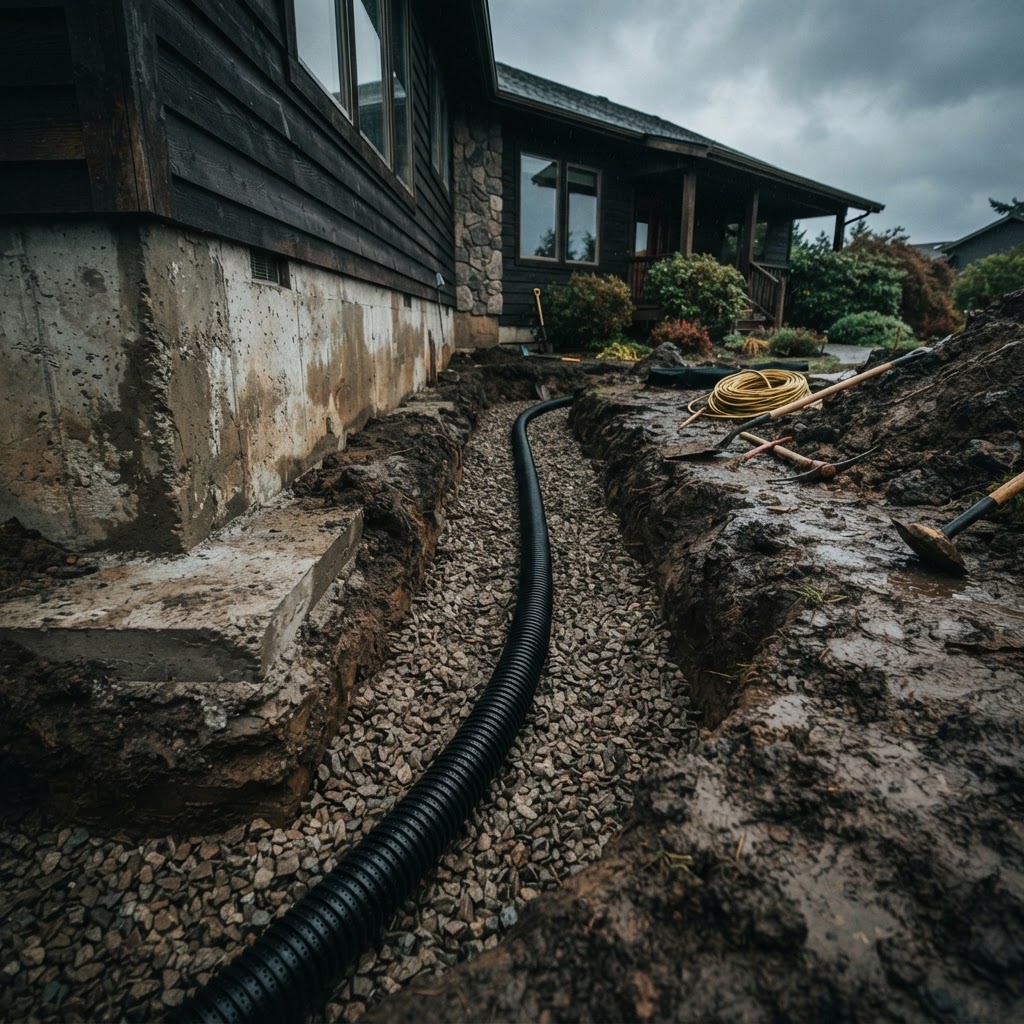
Perimeter Drainage Installation, Inspection and Repair
The perimeter drain (sometimes called a French drain or weeping tile) is the pipe that runs around the outside of your foundation at footing level. Its job is to collect groundwater before it builds up against the foundation wall and carry it away to a sump or storm connection. In coastal BC, where prolonged rain saturates the soil for months at a time, a working perimeter drain is the single most important thing keeping a basement dry. Most perimeter drains in older Metro Vancouver homes are decades old, and a large share of them no longer work the way they were designed to.
What a perimeter drain actually does
When rain falls and soaks into the soil around a house, the water moves downward until it hits the footing. Without a drain at that level, water pressure builds against the foundation and eventually forces its way through cracks, the footing-to-wall joint, or the concrete itself. A perimeter drain gives that water a path of least resistance — into a perforated pipe surrounded by gravel — so it flows away to a sump pit or storm sewer instead of against the wall.
A properly installed system has four parts: a perforated pipe at footing level, clean crushed gravel around the pipe, a filter fabric to keep fine soil from clogging the gravel, and a positive connection to a sump or storm outlet. If any one of these fails, the system stops working.
Signs your perimeter drain may be failing
Perimeter drains fail slowly. The first sign is usually dampness or seepage at the base of a foundation wall after heavy rain, not a full flood.
- Water or dampness at the wall-to-floor joint in a basement or crawlspace
- A white powdery residue (efflorescence) on the foundation wall near the floor
- Mildew smell in a basement that gets worse after rain
- Cracking or spalling of the floor slab near the perimeter
- A sump pump running constantly during wet weather
Perimeter drain inspection
Before recommending repair or replacement, we inspect the existing system. This means exposing the drain at one or two points and running a camera through the pipe to check its condition — whether it is collapsed, full of sediment, root-infested, or still open. An inspection tells us whether a targeted repair is possible or whether the whole system has reached the end of its life.
We will not recommend a full perimeter drain replacement without showing you what the camera found.
Repair vs. replacement
A targeted repair makes sense when one section has failed — a collapsed pipe under a specific stretch, or root intrusion through a single joint — and the rest of the system is still functional. Full replacement is the right call when the pipe is extensively silted, the original installation used materials that have degraded (clay tile, "Big O" corrugated pipe), or the system is so old that repairing one section just moves the failure downstream.
Perimeter Drainage — common questions
Request Drainage Service
Tell us what is happening and where. We will call you back the same business day to discuss the problem and arrange an inspection if needed.