How Does a Perimeter Drainage System Work?
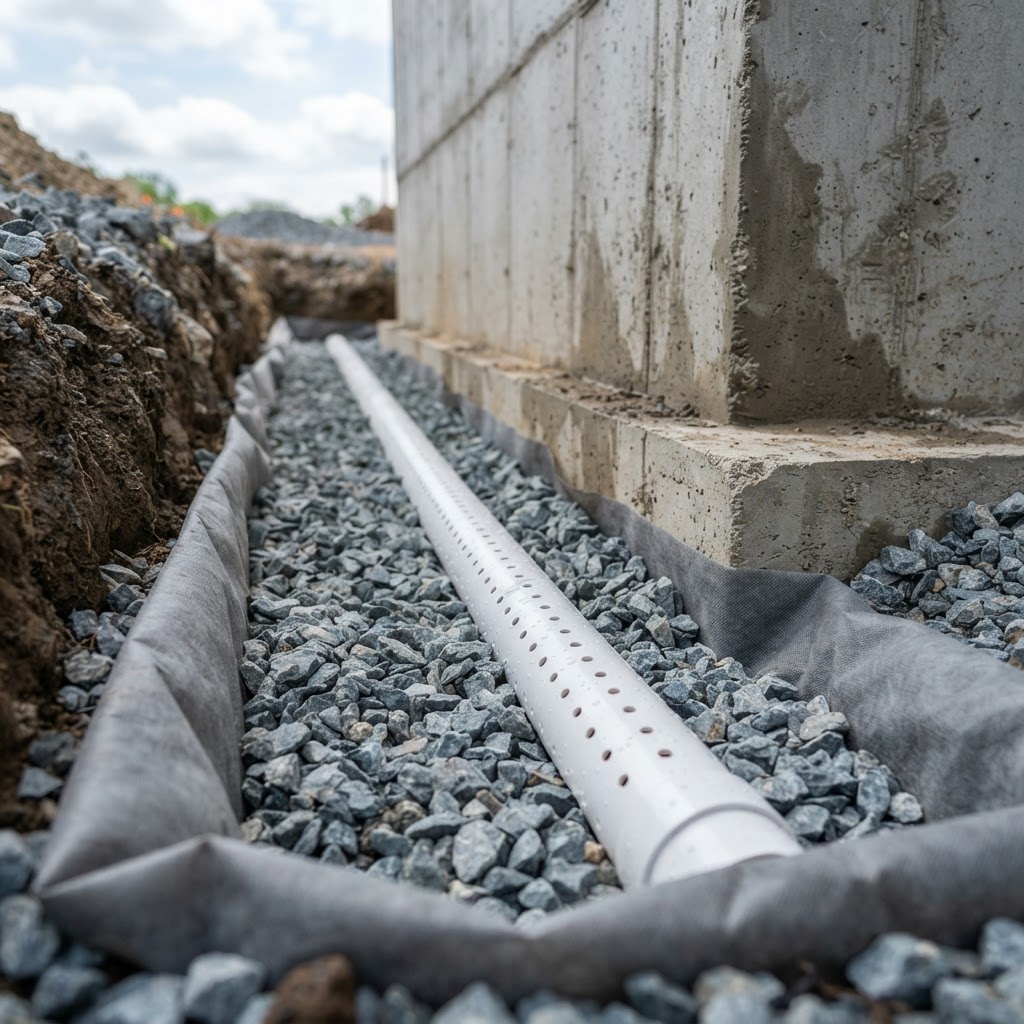
A perimeter drain is a pipe buried at the base of your foundation that gives groundwater a path away from the wall instead of letting it build up against it. Here is how the pieces fit together.
A perimeter drain — sometimes called a weeping tile or French drain, though the terms are not quite interchangeable — is the pipe that runs around the outside of your foundation at footing level. Its job is simple: collect groundwater before it builds up against the foundation wall and carry it away to a sump or storm connection.
The four parts of a working system
A properly installed modern perimeter drain has four components, and if any one of them is missing or failed, the system stops working.
- A perforated pipe laid at the base of the footing, holes facing down, so water enters from below.
- Clean crushed gravel around and over the pipe — the voids between the stones are what let water move freely to the pipe.
- A filter fabric wrapping the gravel to stop fine soil from migrating in and clogging it over time.
- A positive discharge — a connection to a sump pit (with a pump if there is no gravity outlet) or to the storm sewer.
Why the gravel matters as much as the pipe
The pipe is what carries the water away, but the gravel is what lets water reach the pipe. Water moves through the voids between the stones far more easily than through soil, so the gravel envelope effectively enlarges the collection area. Without it, water has to find the pipe directly, which it rarely does efficiently. This is also why filter fabric matters: without it, fine soil washes into the gravel, fills the voids, and the system silts up.
Where the water goes
The collected water needs somewhere to go. If the property has a gravity storm connection, the perimeter drain runs to it. If not — common on flat or low-lying properties — the drain runs to a sump pit, and a pump lifts the water to a discharge point above ground level. A perimeter drain with no effective outlet is just a saturated trench.
If you suspect your perimeter drain is not working, a camera inspection is the first step. See our perimeter drainage page for what an inspection involves and when repair or replacement is needed.
Need this looked at?
If you recognise a problem described here on your own property, we can inspect and tell you what is actually going on.