
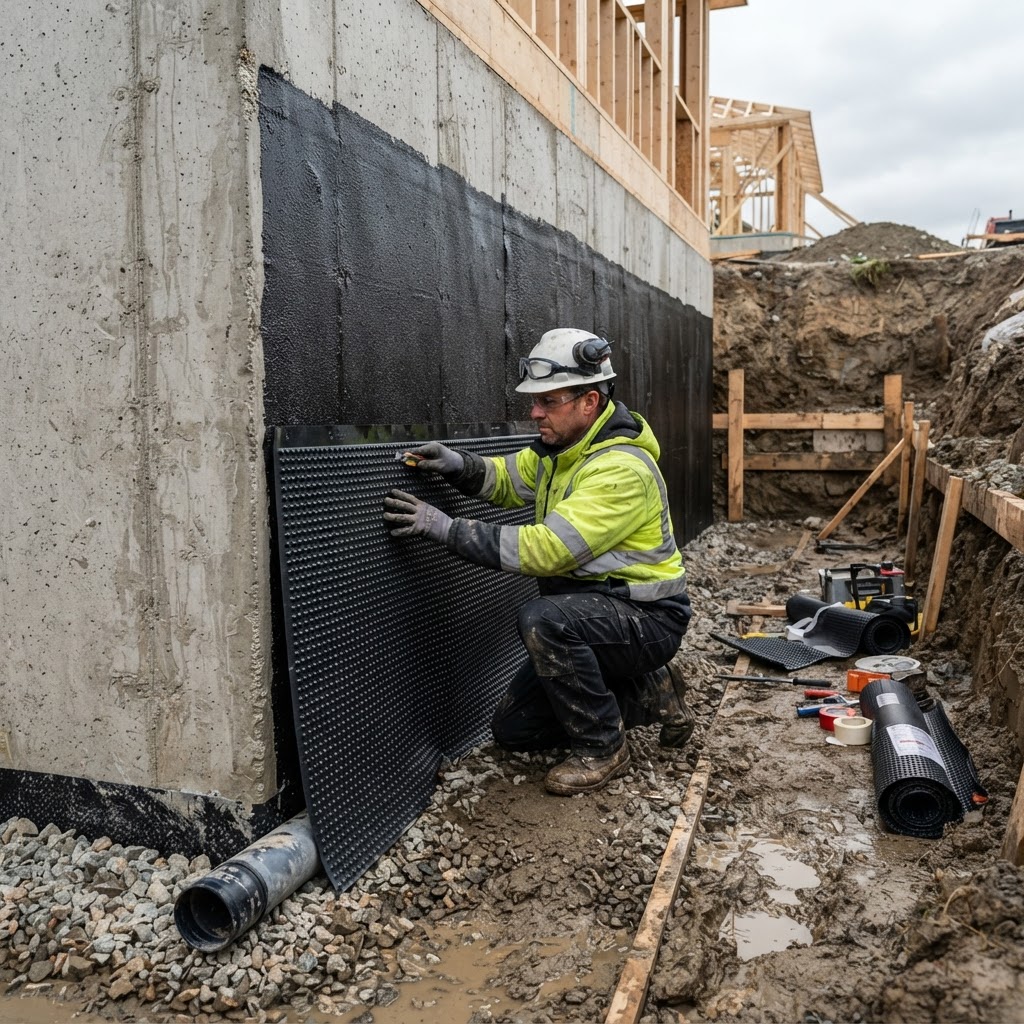
Basement and Foundation Waterproofing
Waterproofing is the layer on the foundation wall that stops water from coming through the concrete itself — distinct from the perimeter drain, which stops water building up against the wall from below. In older Metro Vancouver homes, the original waterproofing was often just a thin coat of bituminous damp-proofing that has long since broken down. When that happens, water soaks through the concrete and enters the basement through the wall, the cold joints, or cracks — and no amount of drainage work at the footing will stop it. We install exterior waterproofing membranes, drainage boards, and crack repairs that keep water out of the wall for the long term.
Stopping water before it reaches your basement
Exterior waterproofing means excavating the wall down to the footing, cleaning the concrete, and applying a waterproofing membrane that bonds to the wall and stays flexible — so it does not crack as the foundation moves or settles over time. Over the membrane, a drainage board (a dimpled sheet) creates an air gap between the soil and the wall, which breaks hydrostatic pressure and lets any water that reaches the wall run straight down to the perimeter drain instead of being forced through the membrane.
This is the system that keeps a basement dry from the wall side. Combined with a functioning perimeter drain at the footing, it addresses both ways water enters — through the wall and from below.
Exterior vs. interior waterproofing
Exterior waterproofing stops water before it enters the wall. Interior waterproofing manages water after it has already come through — typically an interior perimeter channel at the base of the wall that collects water and routes it to a sump pump. Interior systems are less disruptive to install (no exterior excavation) and can be the right choice where exterior access is impossible — a shared wall, a deck, or a finished landscape you cannot dig up.
The honest difference: exterior waterproofing is a permanent fix that stops water at the source. Interior waterproofing is water management — it lets water in and pumps it out. For a finished basement, exterior is the better long-term investment. For an unfinished basement where excavation is not practical, an interior system is a legitimate alternative. We assess the property and give you a straight comparison rather than pushing one approach.
Cracks, cold joints, and the details that matter
Water does not need a large opening to enter a foundation. A hairline crack in a poured concrete wall, a cold joint where two pours meet, or a form-tie hole can all let water through under hydrostatic pressure. For isolated cracks, polyurethane or epoxy injection can seal the crack from inside the wall without excavation — a targeted fix that works when the rest of the wall is sound. When the waterproofing has failed along a section of wall, or there are multiple cracks, a section excavation to re-waterproof that stretch is the lasting fix.
We do not recommend excavating a whole wall when one crack is the problem, and we do not recommend injecting a crack when the waterproofing around it has failed. The inspection tells us which approach matches the actual condition.
A dry basement starts with understanding where the water comes from
Waterproofing and drainage are two halves of the same system, and a basement that stays dry has both working. If only one has failed, you fix that one. If both have failed — common in homes 50 or more years old — you address both, and the order and scope depend on what the inspection shows. We will not sell you a full waterproofing job if the problem is the perimeter drain, and we will not tell you a new drain will fix a wall that is leaking through cracks. The diagnosis comes first.
Basement Waterproofing — common questions
Basement Waterproofing across Metro Vancouver
We have dedicated pages for basement waterproofing in cities across Metro Vancouver and the Fraser Valley. Each covers what the local conditions — soil, slope, housing age, tree cover — mean for that specific service in that area.
Foundation Waterproofing in Vancouver
Read moreFoundation Waterproofing in Burnaby
Read moreFoundation Waterproofing in Richmond
Read moreFoundation Waterproofing in Surrey
Read moreFoundation Waterproofing in North Vancouver
Read moreFoundation Waterproofing in West Vancouver
Read moreFoundation Waterproofing in Coquitlam
Read moreFoundation Waterproofing in Langley
Read moreFoundation Waterproofing in Delta
Read moreFoundation Waterproofing in New Westminster
Read moreFoundation Waterproofing in Port Coquitlam
Read moreFoundation Waterproofing in Port Moody
Read moreFoundation Waterproofing in Maple Ridge
Read moreFoundation Waterproofing in Pitt Meadows
Read moreFoundation Waterproofing in White Rock
Read moreFoundation Waterproofing in Tsawwassen
Read moreBasement Leak Repair in Vancouver
Read moreBasement Leak Repair in Burnaby
Read moreBasement Leak Repair in Richmond
Read moreBasement Leak Repair in Surrey
Read moreBasement Leak Repair in North Vancouver
Read moreBasement Leak Repair in West Vancouver
Read moreBasement Leak Repair in Coquitlam
Read moreBasement Leak Repair in Langley
Read moreBasement Leak Repair in Delta
Read moreBasement Leak Repair in New Westminster
Read moreBasement Leak Repair in Port Coquitlam
Read moreBasement Leak Repair in Port Moody
Read moreBasement Leak Repair in Maple Ridge
Read moreBasement Leak Repair in Pitt Meadows
Read moreBasement Leak Repair in White Rock
Read moreBasement Leak Repair in Tsawwassen
Read moreRequest Drainage Service
Tell us what is happening and where. We will call you back the same business day to discuss the problem and arrange an inspection if needed.