
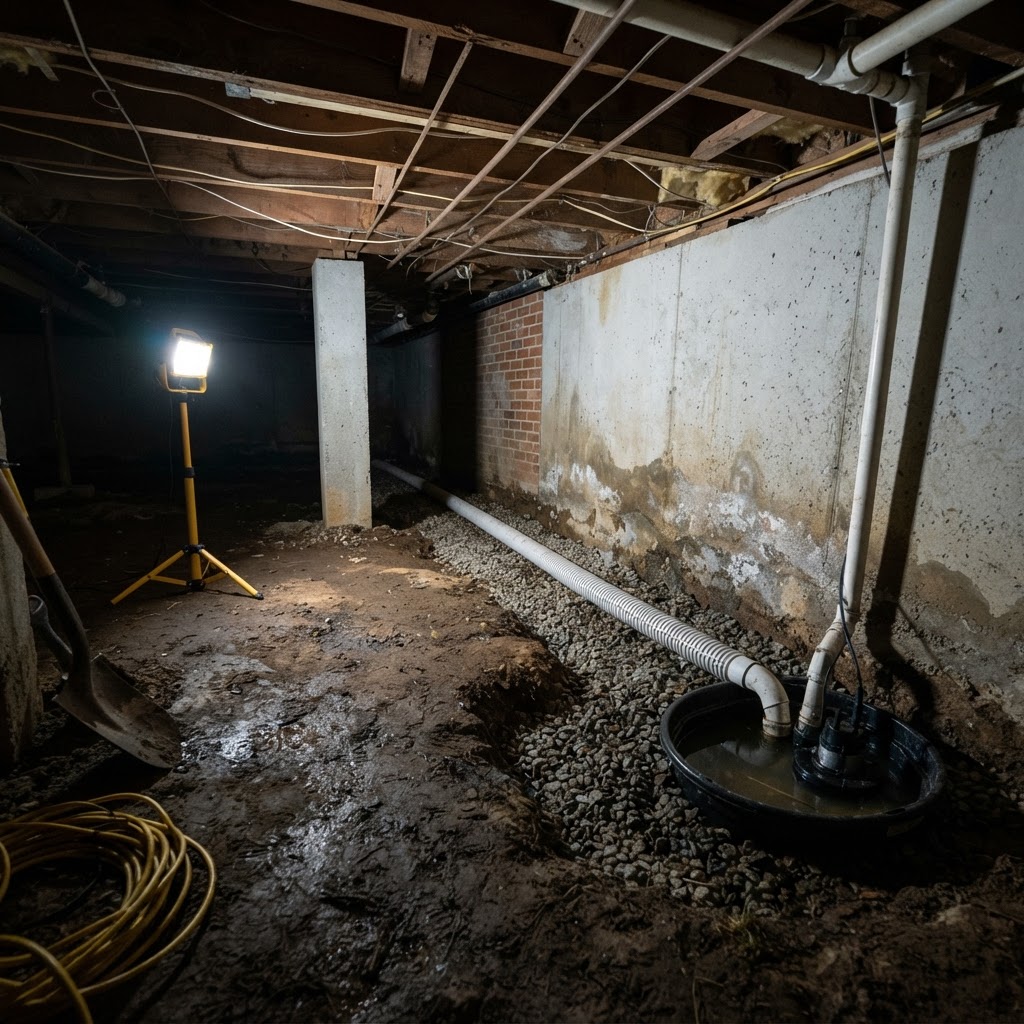
Crawl Space Drainage and Moisture Control
A wet crawl space is a different problem from a wet basement, and the fix is different too. Crawl spaces are closer to the ground, often have dirt floors, and rely on ventilation that does not always work in a damp coastal climate. The result is a space that stays humid, grows mould on the floor joists, rots the insulation, and sends musty air up into the house above. We dry out crawl spaces across Metro Vancouver with a combination of perimeter drainage, vapour barriers, and sump systems — matched to what is actually causing the moisture.
Why crawl spaces stay wet
A crawl space gets wet for one of three reasons, and more than one is often true at the same time. Groundwater or a high water table seeps up through the dirt floor. Surface water runs in through the crawl space vents or walls during rain. Or the perimeter drain at the footing has failed and water builds up against the foundation with nowhere to go.
Because crawl spaces are vented, the moisture does not just sit — it evaporates into the air, raises the humidity, and condenses on the cooler wood and insulation above. That is what causes the mould, the rot, and the musty smell that makes its way into the living space. Drying out a crawl space means addressing the water source first, then managing the moisture that remains.
Drainage, vapour barrier, and ventilation — the three parts
A dry crawl space usually needs all three working together. A perimeter drain at the footing (or a shallow interior trench draining to a sump) carries liquid water out of the space. A vapour barrier — a heavy sealed membrane over the dirt floor and up the walls — stops ground moisture from evaporating into the air. And ventilation, or in some cases a sealed and conditioned approach, manages the humidity that remains.
The most common mistake is putting down a vapour barrier without fixing the drainage underneath. If water is pooling on the dirt floor, a vapour barrier traps it there and the moisture finds another way up. We address the water source first, then seal the floor, then look at whether the ventilation is adequate or whether a different approach makes sense for the space.
When a sump pump is part of the system
In crawl spaces on flat or low-lying properties — common in Richmond, Delta, and Pitt Meadows — gravity alone is not enough to move water out of a perimeter drain or interior trench. A sump pit and pump lift the collected water to a discharge point above ground, and the pump needs to be sized for the volume and have a reliable discharge. We install sump systems as part of a crawl space drainage plan, and we make sure the pump, the discharge, and the power supply are all adequate for the job — because a sump pump that fails in a storm is worse than no system at all.
Crawl Space Drainage — common questions
Request Drainage Service
Tell us what is happening and where. We will call you back the same business day to discuss the problem and arrange an inspection if needed.